

超过60%of workers said they’d consider relocating for a job. But—whether it’s a new city or state—moving from one location to another can quickly get expensive. To sweeten the deal, you can provide relocation assistance.
But before offering help with moving expenses, you may have questions about what it covers, whether it’s taxable, and so on.
What is relocation assistance?
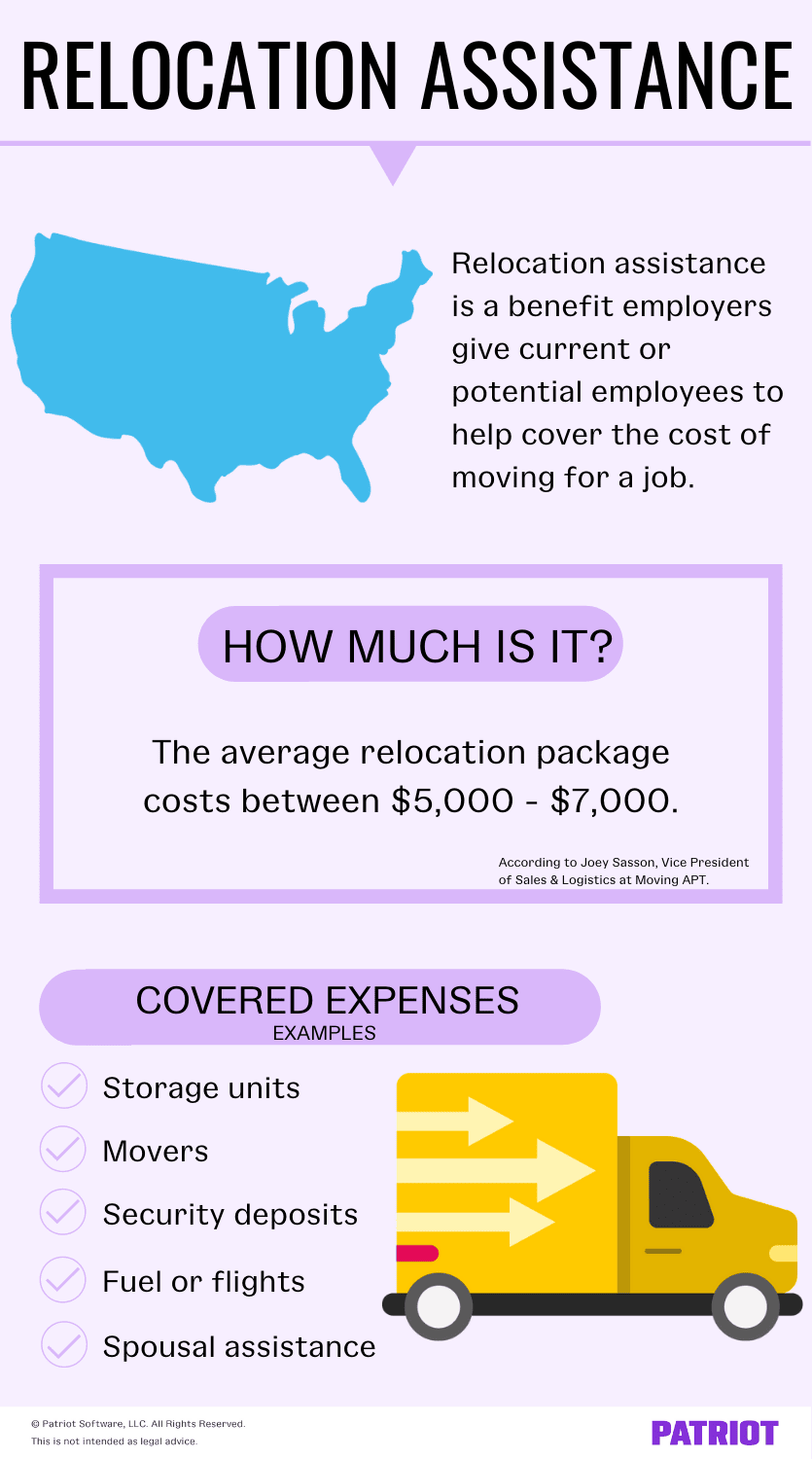
Relocation assistance is a package employers give current or potential employees to help cover the cost of moving for a job. Employers may decide to give an employee relocation assistance as a reimbursement, an upfront lump sum, or a direct payment to the appropriate parties.
A typical relocation package might cover part or all of the expenses associated with:
- 访问新社区
- Movers or moving trucks
- Storage units
- Temporary living expenses
- Spousal assistance (i.e., helping a spouse find work)
- Buying or selling a home (i.e., marketing)
- Breaking lease agreements
- Security deposits
- 燃料或航空公司航班
提供帮助与成本有以移动ts such as attracting senior talent, increasing employee retention, and improving engagement. However, consider the cost of employee relocation.
According to one study, relocating an employee can cost anywhere from $21,327 – $79,425, depending on if they’re renting or owning a home. Of course, you don’t have to pay 100% of the employee’s expenses. In fact, the average relocation lump sum is$7,200 per employee.
Keep in mind that relocation costs vary. Joey Sasson, Vice President of Sales & Logistics atMoving APT, shares his industry insight:
搬迁援助的成本将取决于需要旅行的距离,被搬迁的人数以及所需的援助类型。搬迁援助的总成本可能是数千美元,州际搬家的平均搬迁套餐的成本在5,000至7,000美元之间。”
Why do workers decide to relocate?
Relocation assistance isn’t the be-all and end-all. Employees decide to relocate for a number of reasons outside of receiving corporate relocation packages.
One studyfound that workers relocate for the following top five reasons:
- Better pay / perks (44% of workers)
- Family / personal reasons (17% of workers)
- Cost of living(16% of workers)
- Career advancement (16% of workers)
- Weather (6% of workers)
So, you can further strengthen your ability to attract (and retain) talent by putting together a competitive salary and benefits package and providing growth opportunities.
Taxes and job relocation assistance
Is job relocation assistance taxable?Yes, employers must include moving expense reimbursements in employees’ wages,according to the IRS. But, this wasn’t always the case.
Between tax years 2018 and 2025, the following are suspended, thanks to theTax Cuts and Jobs Act of 2017:
- Moving expenses income tax deduction for employees
- Exclusion from income for qualified moving expense reimbursements
Exception for Armed Forces members:Armed Forces members can still exclude qualifying expense reimbursements from their income if they’re on active duty, they move pursuant to a military order and incident to a permanent change of station, and the expenses would otherwise qualify as a deduction.
Withholding taxes on payments for nondeductible moving expenses
不可用的搬家费用和费用报销应遵守联邦收入,社会保障和医疗保险税款。
Payments for nondeductible moving expenses are a type of supplemental wage.补充工资are additional payments employees receive aside from their regular wages. Other types of supplemental wages include commissions, overtime pay, and back pay.
You can calculate federal income tax on supplemental wages using the supplemental tax rate of 22%. Or, you can calculate federal income tax on the total amount of supplemental plus regular wages if you pay them together.
Calculate Social Security tax and Medicare tax like you do for regular wages.
For more information on withholding taxes from nondeductible moving expenses, check outIRS Publication 15.
Tax gross-up
Withholding taxes from relocation benefits can greatly reduce the employee’s available funds for their move. If you want the employee to receive the full amount of relocation assistance, you can gross up the amount for taxes.
What’s a tax gross-up? A gross-up is when you increase an employee’s gross payment amount to account for taxes. Through a gross-up, the employee gets the specific payment amount (e.g., $5,000 relocation assistance) even after taxes.
To do a gross-up calculation, you can:
- Add up the tax rates that apply to the employee’s wages
- Turn the tax rate into a decimal (e.g., 30% becomes 0.30)
- Subtract the decimal from 1 to get the net percent
- Divide the net wages by the net percent to get the gross amount
Let’s say you want to give an employee relocation assistance of $5,000. The total tax rate that applies to the employee is 29.65% (22% supplemental wage rate + 6.2% Social Security tax + 1.45% Medicare tax). Subtract the decimal form of 29.65% from 1 (1 – 0.2965) to get 0.7035. Now, divide the desired relocation assistance amount ($5,000) by 0.7035 ($5,000 / 0.7035). Your total is $7,107.32. To pay the employee $5,000 after taxes, the gross amount of the relocation assistance must be $7,107.32.
Form W-2 reporting for housing relocation assistance
Report nonqualified moving expenses and expense reimbursements in the following boxes on Form W-2:
- 1: Wages, tips, and other compensation
- 3: Social Security wages
- 5: Medicare wages and tips
- 14: Other (only if railroad retirement taxes apply)
Have an employee who meets the Armed Forces exception? Did you pay qualified moving expense reimbursements directly to the employee? If you answer yes to both questions, report the money in box 12 of Form W-2 with code P. Again, this money is not subject to taxes.
For more information on W-2 reporting of relocation assistance, check out theIRS General Instructions for Forms W-2 and W-3.
Putting together your relocation assistance package
Ready to create a relocation assistance program? Your first order of business is mapping out the terms and conditions of the aid.
Plan out the following details of your housing relocation assistance:
- 支出
- Amount
- Eligible costs
- 投资回收条款
- Taxes
- Qualifying situations
You can include the ins and outs of your package in a relocation assistance agreement and get the employee’s signature. If you have a standard relocation package that you offer existing employees, you might also put it in your employee handbook.
1. Disbursement
How do you plan on giving the employee the relocation assistance?
同样,雇主可能会将搬迁援助的福利视为:
- Lump sum: Pay employees a standard amount regardless of their expenses.
- 报销:根据员工的具体费用(通常达到一定金额)。
- Direct payment to vendors: Pay the employees’ vendors (e.g., moving company) directly.
2. Amount
How much do you want to give the employee for relocation assistance?
If you plan on giving workers a standard lump sum, include the amount here. Or if you plan on giving a relocation stipend based on each employee’s specific expenses, include a reimbursement maximum.
For example, your policy may say:
- Standard upfront lump-sum payment of $5,000 OR
- Employee reimbursement of up to $5,000
3. Eligible costs
Which employee moving expenses do you want to cover?
From bubble wrap to moving trucks, there are countless expenses tied to moving. But, you don’t have to pay forallof them. Define and detail eligible expenses covered under your relocation assistance plan. For example, you may opt to only cover the cost to hire movers.
4. Payback clause
如果员工提早离开公司,您会要求员工偿还搬迁援助吗?
Some employers add a payback clause to their relocation assistance agreement. A payback clause states that the employee must pay back all or part (e.g.,vesting schedule) of the reimbursement if they leave the business before a specified time.
For example, your payback clause may require an employee to pay back relocation assistance if they leave before 18 months.
Adding a payback clause could help you offset the costs of moving an employee who leaves your business earlier than expected.
5. Taxes
Will you do a tax gross-up on the relocation assistance amount?
If you gross up the relocation assistance bonus for taxes, remember to run a net to gross payroll. Again, you can simplify this process by usingvwin.comac德赢官方首页 .
6. Qualifying situations
Which situations qualify for relocation assistance?
确定您是否会为新员工或现任员工提供帮助。并且,确定您是否只能向整个州或全国各地移动的人提供帮助。
例如,您可能会提供两者:
- In-state relocation assistanceAND
- Out-of-state relocation assistance